5-Minute Muscle Workout for Seniors (60+)
Simple Muscle Workouts for Seniors (60+)
Many of us reach a point where movements that were once effortless start to feel challenging. Even simple actions like standing up after sitting can put a strain on the knees and back, making our whole body feel heavy and sluggish. This change is often more closely linked to a decrease in muscle usage than just simple fatigue. When the muscles that support our body weaken, our activity levels tend to drop, which can further accelerate a decline in stamina. That's why maintaining the strength of our body is becoming more important than simply focusing on long walks.
The Importance of Muscles
Muscles are not just for exerting force; they play a crucial role in maintaining overall bodily functions. They provide stability and balance, and also influence blood circulation, body temperature regulation, and basal metabolic rate. When muscle mass decreases, we tend to get tired more easily, and even small movements can quickly deplete our energy. The difference in vitality between individuals, even with similar lifestyles, is often connected to their muscle condition. Ultimately, a healthy body is more about the strength to move than just the number on the scale.
The Benefits of Short Workouts
Many people believe that exercise only becomes effective after a long duration. However, in reality, movements that engage the entire body properly can be more impactful. Actively using your muscles, even for a short time, can lead to surprisingly quick responses from your body. Activating core and lower body muscles together can positively affect posture stability and balance. The process of repeatedly supporting and holding your body weight can effectively stimulate deep, intrinsic muscles. This is why the way you use your body is becoming more emphasized than the duration of your workout.
Introducing the Exercises
Now, let me introduce a few simple exercises that seniors (60+) can easily follow.
- Knee Hug: Lie on your back and lift your legs. Bring one knee towards your chest, hugging it with your hands. Keep the other leg extended straight. Alternate sides. Benefits: Stimulates the lower abdomen, improves core coordination.
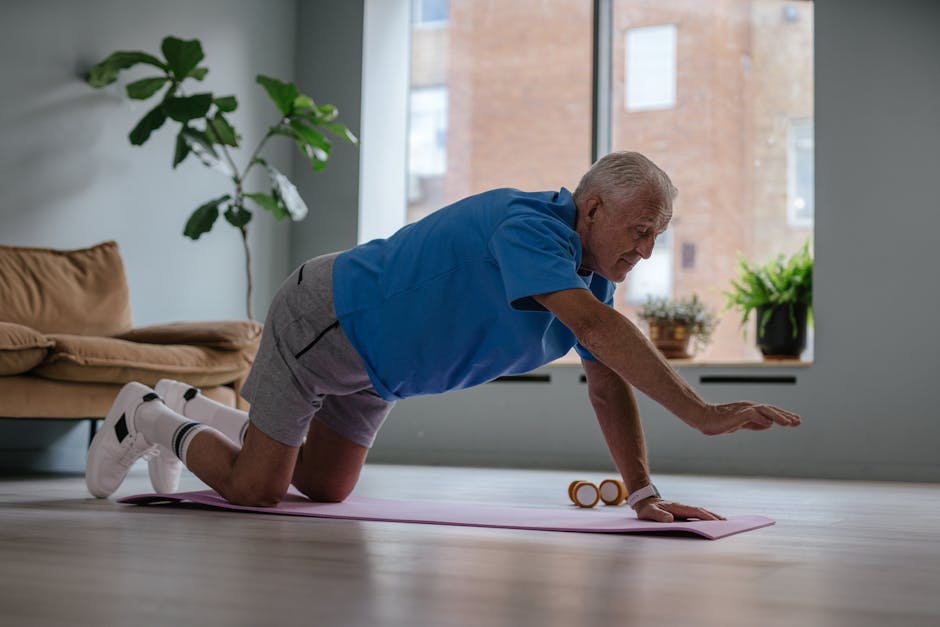
- Tabletop Pose: Start on all fours. Simultaneously extend one arm forward and the opposite leg backward. Return to the starting position and alternate sides. Benefits: Improves spinal stability and posture.
- Upper Body Lift: Lie on your back with your knees bent and feet flat on the floor. Extend your arms forward and slowly lift your upper body. Benefits: Strengthens upper abdominal muscles and improves core tone.
- Glute Bridge: Lie on your back with your knees bent and feet flat on the floor, hip-width apart. Slowly lift your hips off the floor. Benefits: Enhances lower body tone and improves postural stability.
Consistent Management for a Healthy Body
The feeling of heaviness and the difficulty with everyday movements, more so than just age, are often deeply connected to a decrease in muscle usage. When the muscles supporting the body, particularly in the lower body and core, weaken, the strain on the hips and knees increases, and movements can become progressively slower. Therefore, maintaining core stability by evenly engaging the entire body's muscles is becoming more important than engaging in long workouts. Once your muscles start to reactivate, you'll find that walking and movements like sitting up will become much easier, and you'll experience a newfound sense of stability as your entire body feels more supported.